

The Ultimate MEXT Scholarship 3.0 GPA Scale Guide
Thousands of brilliant international students face instant rejection from the Japanese Government Scholarship program every year, not because they lack intelligence, but because of a simple math error. The Ministry of Education, Culture, Sports, Science and Technology (MEXT) does not evaluate your academic history using the standard American 4.0 scale or the British percentage system. They use a highly specific Japanese grading metric.
If you fail to convert your grades accurately before submitting your application, the embassy will discard your paperwork during the primary screening.
This comprehensive MEXT Scholarship 3.0 GPA Scale Guide provides the exact framework you need to translate your local university or high school transcripts into the Japanese standard. By the end of this article, you will know precisely how to calculate your academic standing and verify if you meet the strict 2.30 baseline required to secure your fully funded education in Japan.
1. What is the Japanese 3.0 Grading System?
Related Reading: Check out our guide on Study in Hungary: Full Guide to Free Education
Most international grading systems reward an "A" with a 4.0 and a "B" with a 3.0. Japan operates on a flatter scale. In the MEXT system, the maximum achievable grade point is 3.0, and the minimum passing point is 0.
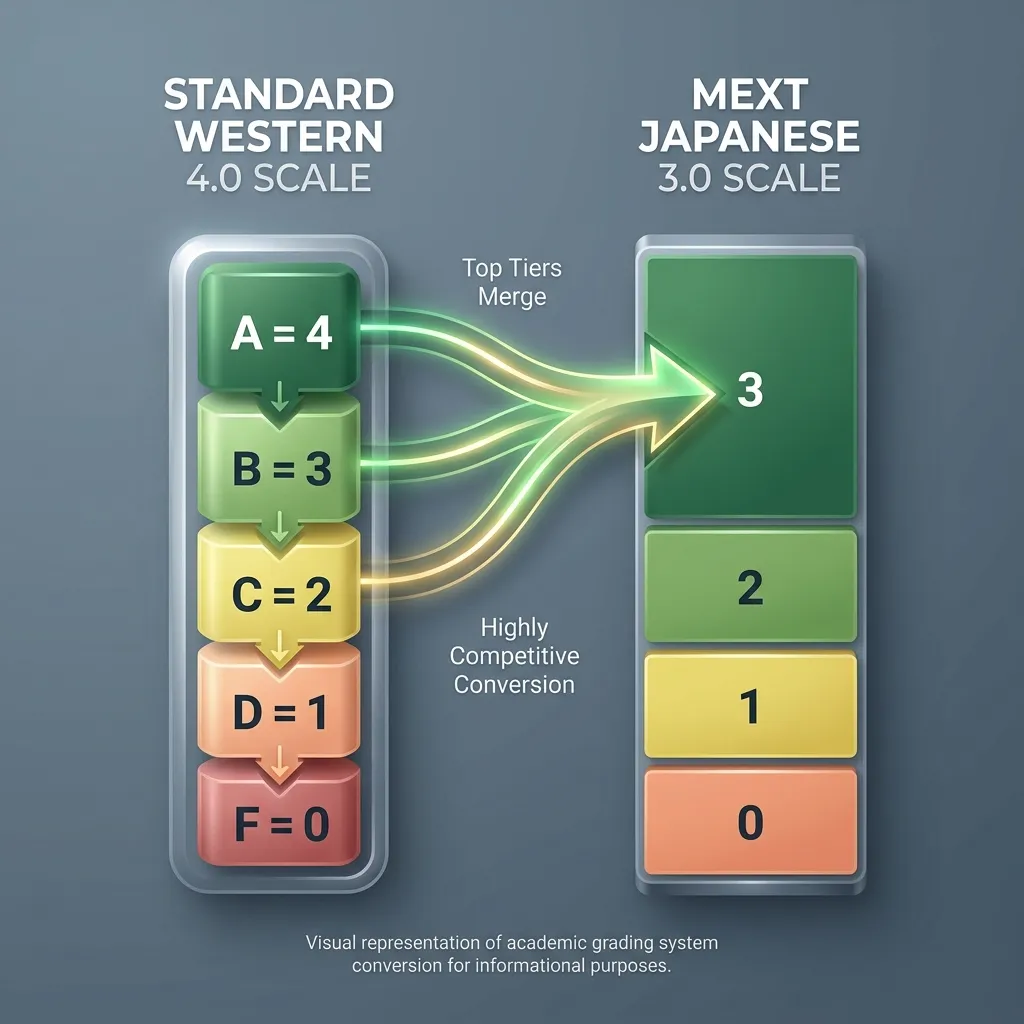
The selection committee requires a minimum MEXT GPA of 2.30 out of 3.00 from your most recent academic degree.
Why do they use this system? Because Japan receives applications from over 150 countries. Embassies need a unified, objective mathematical formula to compare a student from a British 100-point percentage system directly against a student from a German 1-to-6 numbering system. This MEXT Scholarship 3.0 GPA Scale Guide simplifies that complex normalization process.
2. Step-by-Step MEXT Scholarship 3.0 GPA Scale Guide
Converting your academic history requires a methodical approach. Do not simply guess your average. Follow these exact steps to ensure your embassy application is flawless.
Step 1: Identify Your Native Grading Tier
First, look at your official transcript's legend (usually found on the back of the document). You need to determine if your school uses a 4-tier, 5-tier, or percentage-based grading system.
-
4-Tier Example: A, B, C, F
5-Tier Example: S, A, B, C, F (or A, B, C, D, F)
Percentage Example: 100-80%, 79-70%, 69-60%, etc.
Step 2: Assign the MEXT Grade Points
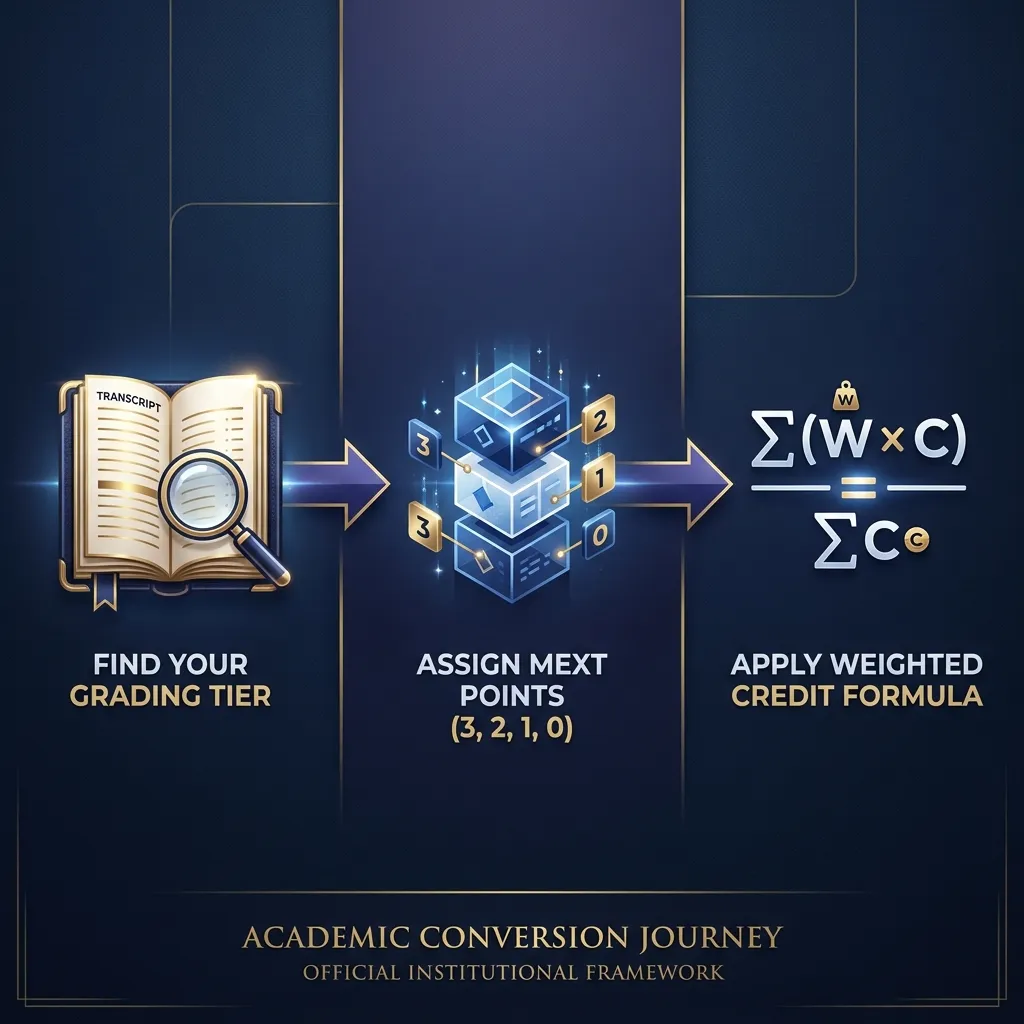
Once you identify your tier, you must assign a MEXT value (3, 2, 1, or 0) to every single class you have taken.
-
Top tier grades (e.g., A or 80-100%) = 3 Points
Upper-middle grades (e.g., B or 70-79%) = 2 Points
Lower-middle grades (e.g., C or 60-69%) = 1 Point
Failing grades = 0 Points
Step 3: Apply the Official Calculation Formula
This is the core of our MEXT Scholarship 3.0 GPA Scale Guide. You cannot just average the points. You must multiply them by the number of credits each class is worth.
Use this exact formula:
((Credits with 3 points x 3) + (Credits with 2 points x 2) + (Credits with 1 point x 1) + (Credits with 0 points x 0)) / Total Registered Credits
3. The Official MEXT Grade Conversion Table
To make Step 2 easier, use this standard conversion table provided by the Japanese Ministry. Find your country's grading style in the columns below, and track it right to find your MEXT Grade Point.
| Your Native Grading System | Top Grade (3 Pts) | High Grade (2 Pts) | Passing Grade (1 Pt) | Failing Grade (0 Pts) |
| 4-Tier Pattern 1 | Excellent | Good | Fair | Fail |
| 4-Tier Pattern 2 | A | B | C | F |
| 4-Tier Pattern 3 | 100% - 80% | 79% - 70% | 69% - 60% | 59% or below |
| 5-Tier Pattern 1 | S / A | B | C | D |
| 5-Tier Pattern 2 | A / B | C | D | E |
| 5-Tier Pattern 3 | 100% - 90% / 89% - 80% | 79% - 70% | 69% - 60% | 59% - 50% |
Pro-Tip: Notice how the 5-Tier Pattern 3 combines the top two tiers (100-90% and 89-80%). In the MEXT system, an 85% and a 95% both award you the maximum 3.0 points.
4. Unique Value: Edge Cases and Hidden Pitfalls
Even with a detailed MEXT Scholarship 3.0 GPA Scale Guide, many students encounter unusual situations on their transcripts. Here is how to handle the most common "edge cases" that lead to application rejections.
Dealing with Pass/Fail Courses
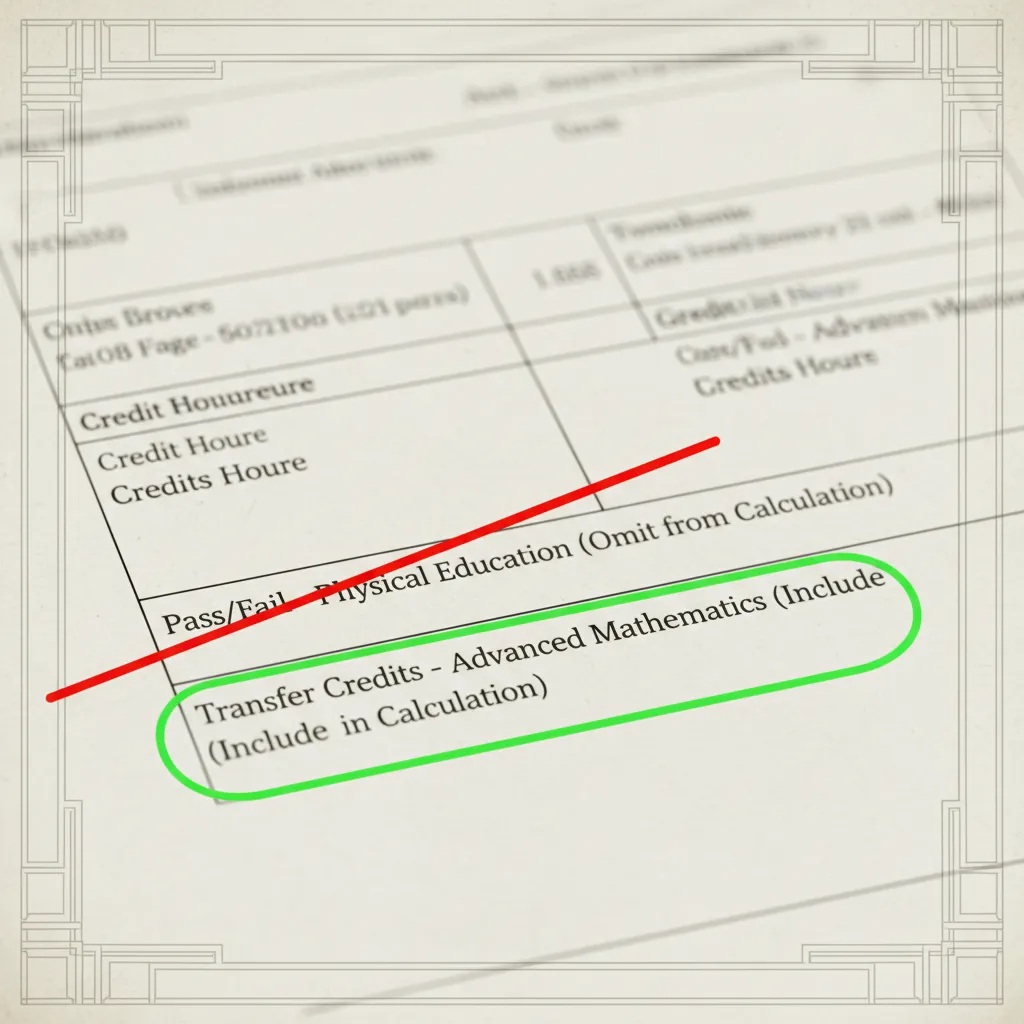
If you took a class that only issued a "Pass" or "Fail" without a specific letter grade or percentage, do not include it in your calculation. You must omit the grade and the credits for that specific course from the formula entirely. Including it will break the math and invalidate your sheet.
Transfer Credits and Multiple Degrees
If you transferred universities halfway through your degree, you must combine the credits and grades from both institutions into one master calculation. However, if you are applying for a Master's program and already hold two distinct Bachelor's degrees, only calculate the GPA for the degree most relevant to your proposed research in Japan.
10-Point and European ECTS Scales
If your country uses a 10-point scale (common in Latin America and parts of Europe), convert it to percentages first (e.g., an 8.5/10 becomes an 85%). If you use the European Credit Transfer and Accumulation System (ECTS), map your A-F grades directly to the 5-Tier pattern in the table above.
5. What to Do If You Fall Below the 2.30 Threshold?
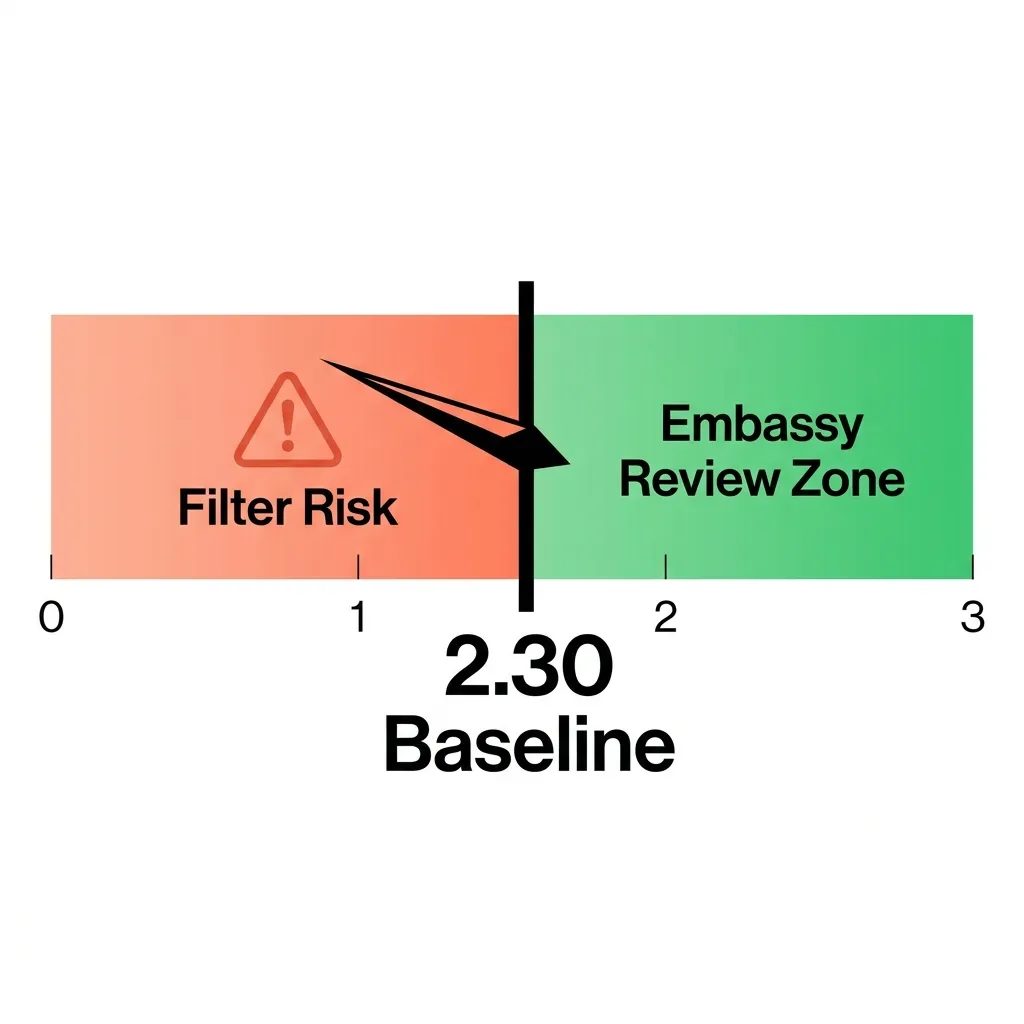
A harsh reality of the application process is that some students will follow this MEXT Scholarship 3.0 GPA Scale Guide and realize their score is a 2.15 or 2.25.
If your score falls below 2.30, you face an uphill battle. The embassy typically filters out these applications automatically. However, you have two potential workarounds:
-
The University Recommendation Route: Instead of applying through the embassy, apply directly to a Japanese university. While they still check your grades, professors have slightly more leeway to advocate for a student with a lower GPA if their research proposal is groundbreaking or they have significant professional publications.
Explain the Anomaly: If your overall GPA is dragged down by a terrible first year, but your final two years show a perfect 3.0 trajectory, attach an official addendum to your application. Explain the academic upward trend. Japanese universities value growth and resilience.
Authoritative Conclusion
Securing your place in Japan requires more than just a passion for the culture; it demands administrative precision. By utilizing this MEXT Scholarship 3.0 GPA Scale Guide, you eliminate the guesswork and ensure the embassy evaluates your application based on your true academic merit.
Take an hour this weekend to sit down with your official transcripts, a calculator, and the formula provided above.