

How to Calculate MEXT GPA Score: Step Guide
Securing the prestigious Ministry of Education, Culture, Sports, Science and Technology (MEXT) scholarship can fully fund your academic journey in Japan. However, the initial screening process presents a major bottleneck for global applicants. Before the embassy reviews your research proposal or interviews you, your academic transcripts must clear a strict screening threshold.
The biggest hurdle for international students is realizing that their home country's grading system does not align with the system used in Japan. To apply, you must prove you meet the mandatory minimum threshold of 2.30 out of a 3.00 scale.
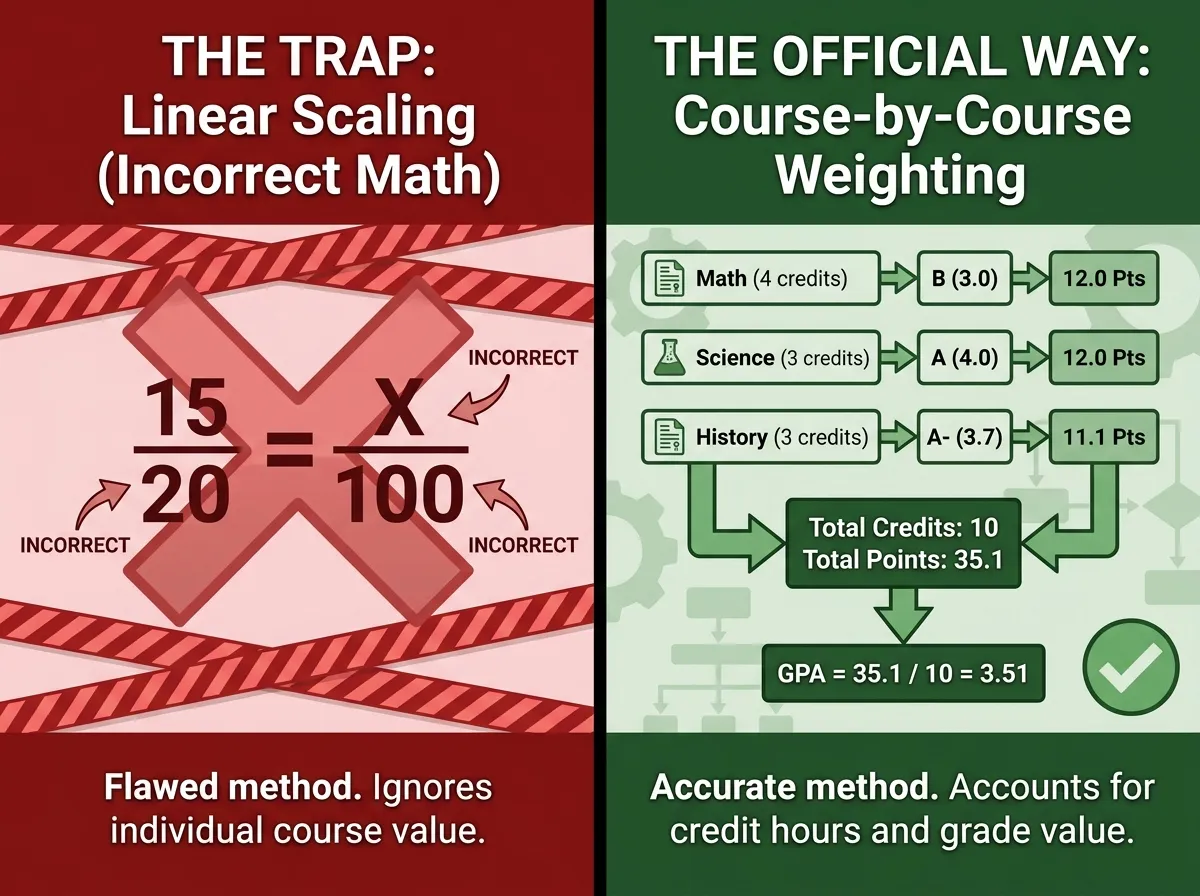
If you try to simply scale down your home country cumulative grade linearly, you will get an incorrect number. This guide provides the official methodology to accurately calculate MEXT GPA score metrics so you can verify your eligibility before submitting your paperwork.
Step 1: Map Your Grades to the Japanese Scale
Related Reading: Check out our guide on Chevening Scholarship for 2027: Requirements & Apply
The Japanese government standardizes all international transcript systems by converting them into a specific 3.0-point grading bucket scale. To calculate MEXT GPA score targets, look at the historical evaluation framework of your university.
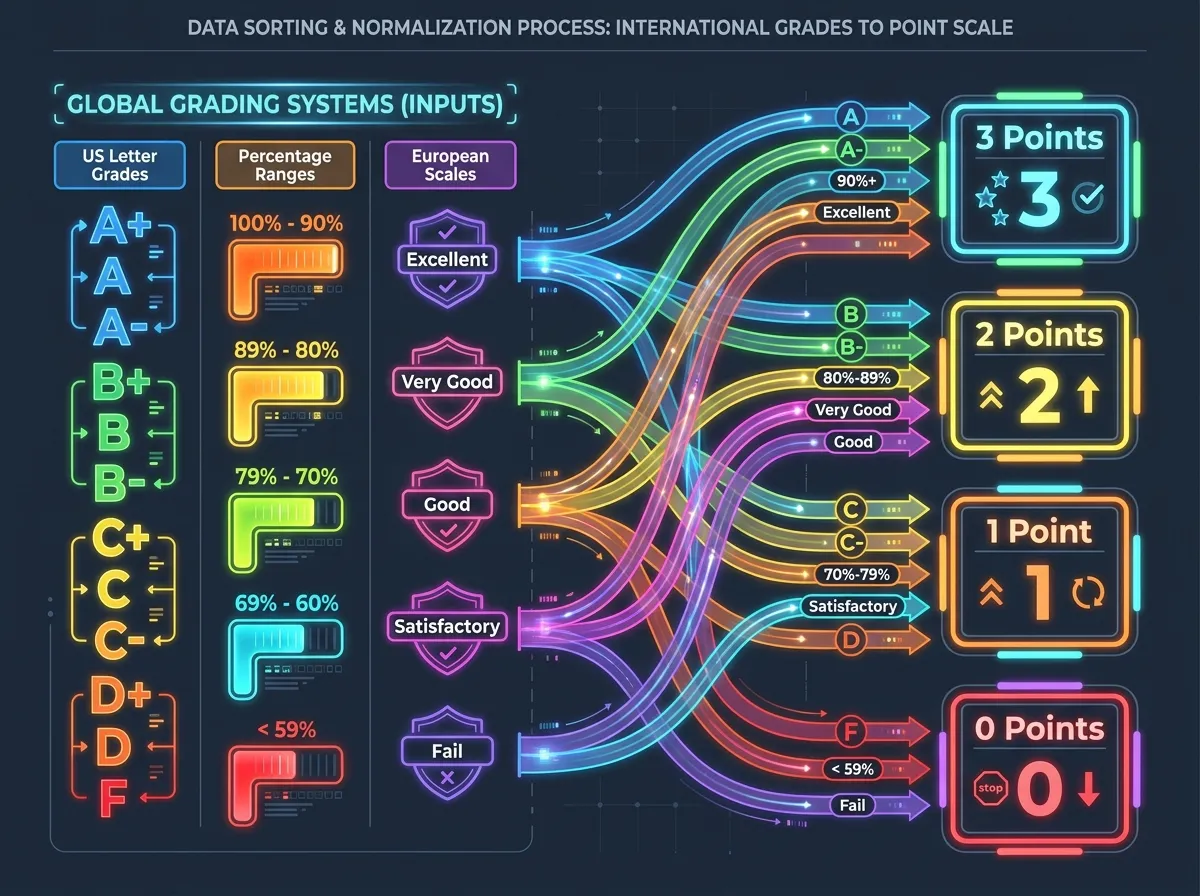
Find the grading legend on the reverse side of your official transcript. Match your specific institutional patterns to the official conversion grid below.
The Official MEXT Grade Conversion Chart
| Grading System Type | Grade Point 3 | Grade Point 3 | Grade Point 2 | Grade Point 1 | Grade Point 0 |
| 4-Level Scale (Pattern 1) | Excellent | Good | Fair | — | Fail |
| 4-Level Scale (Pattern 2) | A | B | C | — | F |
| 4-Level Scale (Pattern 3) | 100 – 80% | 79 – 70% | 69 – 60% | — | Below 59% |
| 5-Level Scale (Pattern 4) | S | A | B | C | F |
| 5-Level Scale (Pattern 5) | A | B | C | D | F |
| 5-Level Scale (Pattern 6) | 100 – 90% | 89 – 80% | 79 – 70% | 69 – 60% | Below 59% |
Pro-Tip: Notice that for a 4-level scale, both an "Excellent" and a "Good" (or an "A" and a "B") map directly to a top score of 3. This distinct feature can significantly boost your final numbers compared to traditional linear conversions.
Step 2: Apply the Official MEXT GPA Formula
Once every individual course grade is mapped to a value between 0 and 3, apply the official weighted formula. You must evaluate every single course taken within the last two academic years.
$$MEXT \; GPA = \frac{(C_3 \times 3) + (C_2 \times 2) + (C_1 \times 1) + (C_0 \times 0)}{C_{Total}}$$
Where:
-
$C_3$ = Total credits earned from courses with a Grade Point of 3
$C_2$ = Total credits earned from courses with a Grade Point of 2
$C_1$ = Total credits earned from courses with a Grade Point of 1
$C_0$ = Total credits earned from courses with a Grade Point of 0
$C_{Total}$ = The sum total of all registered credits across those two years
Step-by-Step Calculation Example
Let's assume an applicant completed 4 courses during a university semester:
-
Advanced Mathematics: 4 Credits, Grade: A (Maps to 3) $\rightarrow 4 \times 3 = 12$
Organic Chemistry: 3 Credits, Grade: C (Maps to 1) $\rightarrow 3 \times 1 = 3$
Academic English: 2 Credits, Grade: B (Maps to 2) $\rightarrow 2 \times 2 = 4$
World History: 3 Credits, Grade: Fail (Maps to 0) $\rightarrow 3 \times 0 = 0$
Now, add the total calculated points together:
$$12 + 3 + 4 + 0 = 19 \; \text{points}$$
Next, sum the total number of credits registered during that period:
$$4 + 3 + 2 + 3 = 12 \; \text{credits}$$
Finally, divide the total points by the total credits to calculate MEXT GPA score results:
$$19 / 12 = 1.583$$
Common Mistakes Students Make When Calculating
1. Linearly Scaling Your Cumulative Score
Many applicants look at their final home university score (for example, a 3.2 out of 4.0) and attempt to multiply it by a fraction ($3.2 \times 0.75 = 2.4$). This math is completely incorrect for this application and will invalidate your paperwork. You must convert your transcript line-by-line, course-by-course.
2. Misapplying Rounding Rules
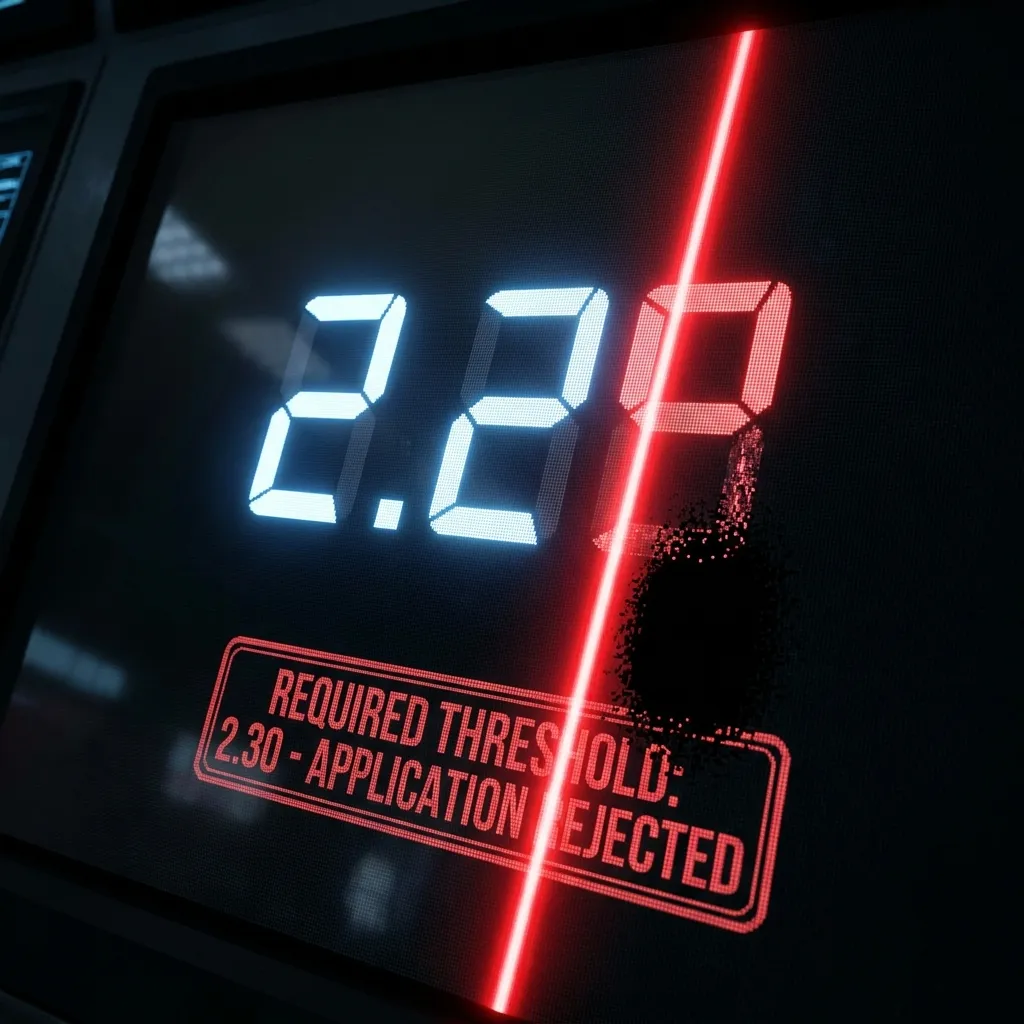
Unlike standard math conventions, the evaluation committees are strict regarding thresholds. If your calculated final score is 2.299, it does not round up to a 2.30. The value drops off after the second decimal place, making you ineligible for submission. Always drop trailing digits rather than rounding up.
3. Omitting Failed Classes
If you failed a course during your last two years of study, you cannot leave it off the sheet to protect your average. Failed courses count as 0 grade points in the equation, while their credit weights remain in the divisor, pulling down your final output.
Inside the Screening System: Unique Rules You Won't Find on Basic Blogs
While standard calculation guides show you basic formulas, university administrative offices utilize internal processing rules that significantly alter your strategy.
-
Non-Credit Systems: If your home college evaluates performance based on modular courses rather than semester hours, change the credit numbers to 1 for each distinct class completed.
Pass/Fail and Audit Distinctions: Classes that issue a simple "Pass" or "Approved" mark are excluded from the equation entirely. However, if a class lists a "Fail" under a binary pass/fail option, it must be included as a 0-point course.
The Transfer Student Variable: If you transferred institutions midway through your program, only the marks earned at your final degree-granting institution count, unless your old grades are explicitly calculated into your new transcript's GPA values.
What If Your Score Falls Below 2.30?
Discovering that your calculated score sits below the 2.30 baseline can be discouraging, but it does not mean your goal of studying in Japan is over.
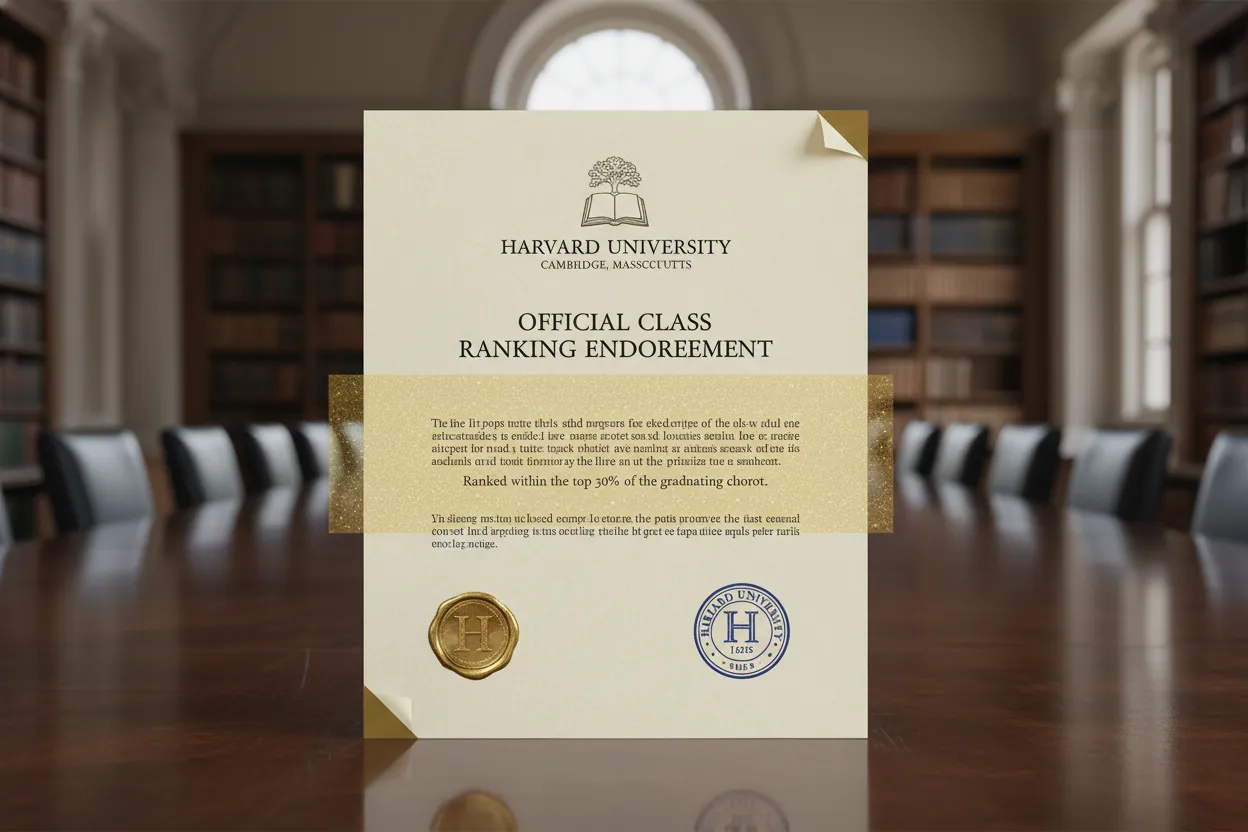
If your score falls below the requirement, you can request an official ranking endorsement letter from your university dean or department head. This document must explicitly state that despite your transcript's conversion numbers, you rank within the top 30% of your graduating class.
Embassies accept objective institutional proof of class rank as an alternative pathway to verify your academic performance.
Final Strategy Check
Accurately figuring out how to calculate MEXT GPA score benchmarks gives you a realistic view of your application status. Take the time to build a course-by-course spreadsheet of your transcripts from the past two years.
If you clear the 2.30 marker, you can confidently shift your focus to polishing your research proposal, securing solid letters of recommendation, and mastering your language proficiency exams to stand out in a competitive global field.