

Convert GPA to Japanese 3.0 Scale: Step Guide
When you apply for prestigious Japanese pathways like the MEXT scholarship or a JASSO grant, the very first administrative hurdle you face is purely mathematical. Japanese academic institutions do not use the standard 4.0 scale common in North America, nor do they use European ECTS percentage bands directly. Instead, they evaluate international candidates using a specialized, weighted 3.0-point system.
Many qualified applicants see their applications rejected early simply because they guess their numbers or use an online calculator that relies on basic cross-multiplication. To secure your eligibility, you must convert your transcript manually using the official government methodology. This guide breaks down the exact process so you can confirm your standing.
Step 1: Map Your Individual Course Grades
Related Reading: Check out our guide on Chevening Scholarship for 2027: Requirements & Apply
You cannot look at your final cumulative GPA to find your new score. You must look at your transcripts and evaluate every single course grade received over your last two academic years of study.
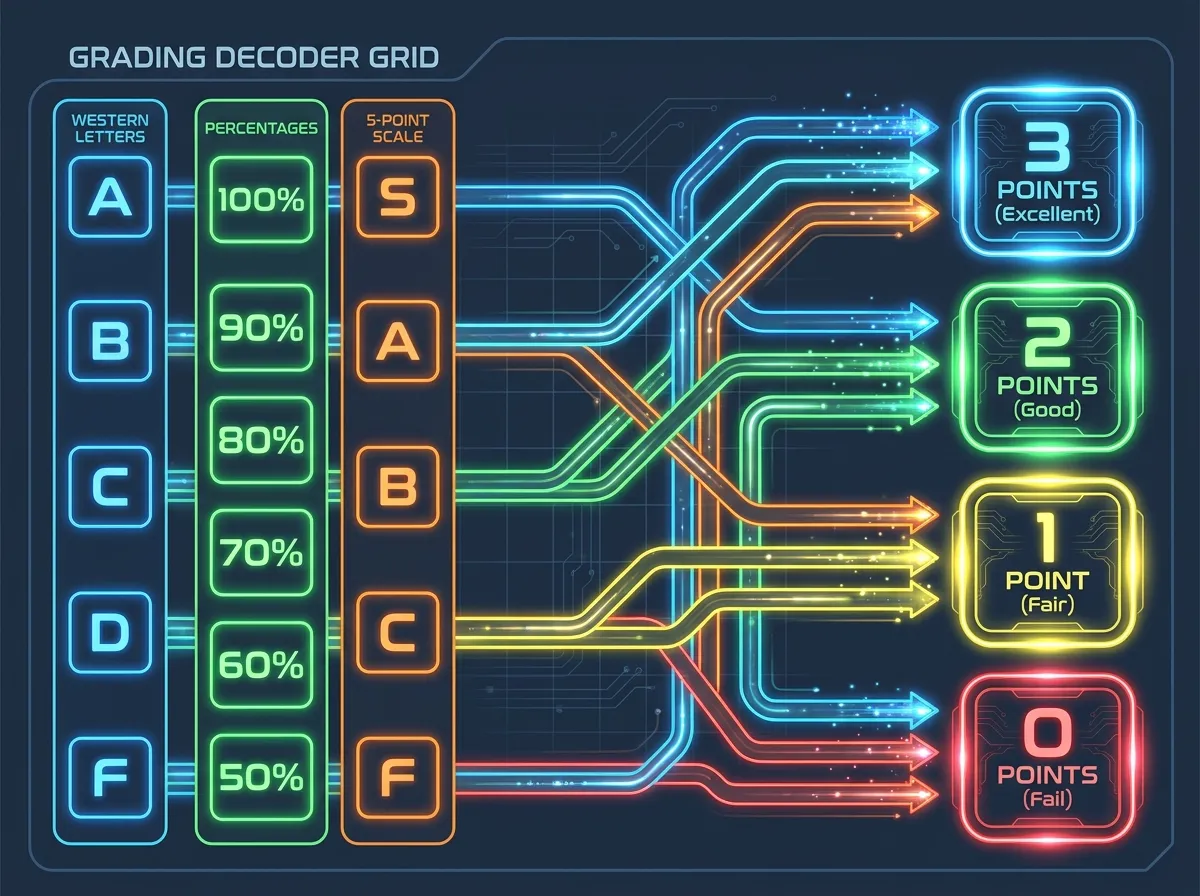
Locate the official grading legend on the back of your university transcript. Use that legend to map your specific letter grades or percentage scores to the official Japanese evaluation points below.
The Official Japanese Grade Mapping System
| Grading Scale Style | 3 Points | 3 Points | 2 Points | 1 Point | 0 Points |
| Type 1 (4-Level Scale) | Excellent | Good | Fair | — | Fail |
| Type 2 (4-Level Scale) | A | B | C | — | F / FX |
| Type 3 (4-Level Scale) | 100 – 80% | 79 – 70% | 69 – 60% | — | Below 59% |
| Type 4 (5-Level Scale) | S / Great | A | B | C | F |
| Type 5 (5-Level Scale) | A | B | C | D | F |
| Type 6 (5-Level Scale) | 100 – 90% | 89 – 80% | 79 – 70% | 69 – 60% | Below 59% |
Pro-Tip: Notice that in 4-level scales, both an "A" and a "B" convert into a top-tier score of 3. Because of this structural quirk, your converted average can often end up higher than your original institutional score.
Step 2: Run the Official Weighting Formula
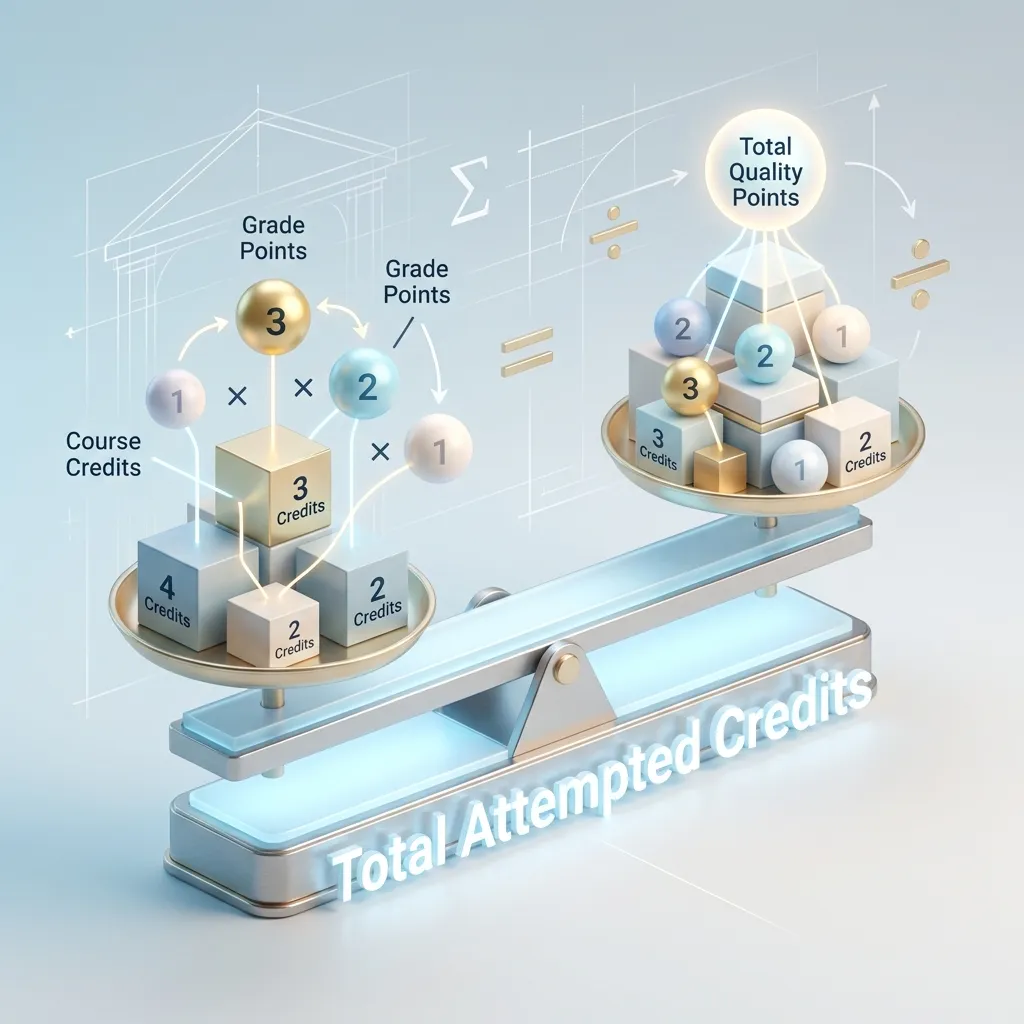
Once you have converted every single individual class mark into a value between 0 and 3, plug those values into the official weighted equation. This equation scales your marks against the credit weight of each class.
$$Converted \; GPA = \frac{(N_3 \times 3) + (N_2 \times 2) + (N_1 \times 1) + (N_0 \times 0)}{Credits_{Total}}$$
Where:
-
$N_3$ = Sum of credits from classes that mapped to 3 points
$N_2$ = Sum of credits from classes that mapped to 2 points
$N_1$ = Sum of credits from classes that mapped to 1 point
$N_0$ = Sum of credits from classes that mapped to 0 points (Failed courses)
$Credits_{Total}$ = The total number of credits you registered for during those two years
A Concrete Conversion Example
Imagine a student completed three courses in their most recent university term:
-
Advanced Economics: 3 Credits, Grade: A (Maps to 3 Points) $\rightarrow 3 \times 3 = 9$
Statistical Methods: 4 Credits, Grade: C (Maps to 1 Point) $\rightarrow 4 \times 1 = 4$
Political Science: 3 Credits, Grade: B (Maps to 2 Points) $\rightarrow 3 \times 2 = 6$
First, calculate the total points earned:
$$9 + 4 + 6 = 19 \; \text{points}$$
Next, find the total number of credits attempted:
$$3 + 4 + 3 = 10 \; \text{credits}$$
Finally, divide your total points by your total credits to convert GPA to Japanese 3.0 scale results:
$$19 / 10 = 1.90$$
Why Your Cumulative GPA Strategy Fails
The Cross-Multiplication Trap
The single most common mistake candidates make is using simple cross-multiplication. For instance, if a student has a 3.4 out of 4.0, they might assume they can solve for $X$ ($3.4 / 4.0 = X / 3.0$), which yields a 2.55.
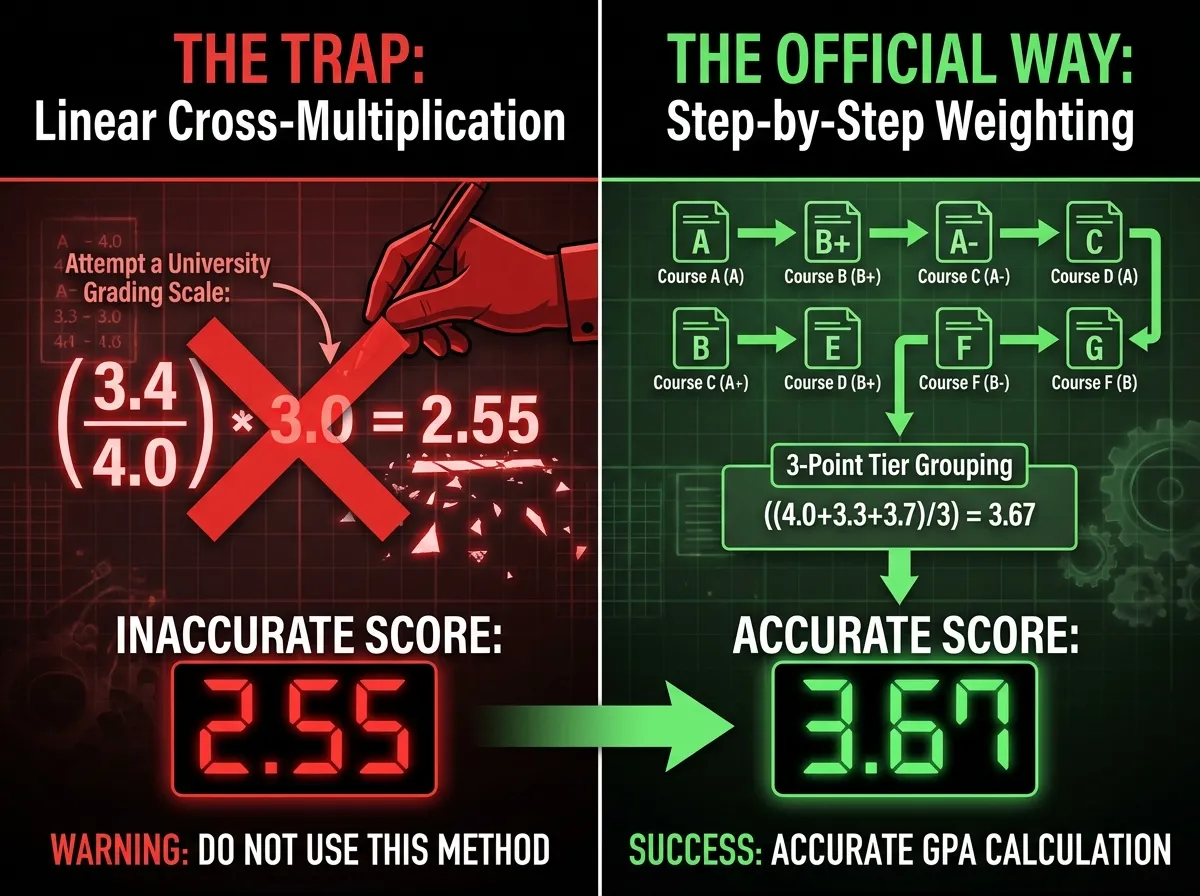
Japanese universities do not accept this shortcut. Because the official system groups multiple top grades (like A and B) into the highest 3-point tier, the step-by-step mathematical output is completely different from a linear conversion.
The Rounding Penalty
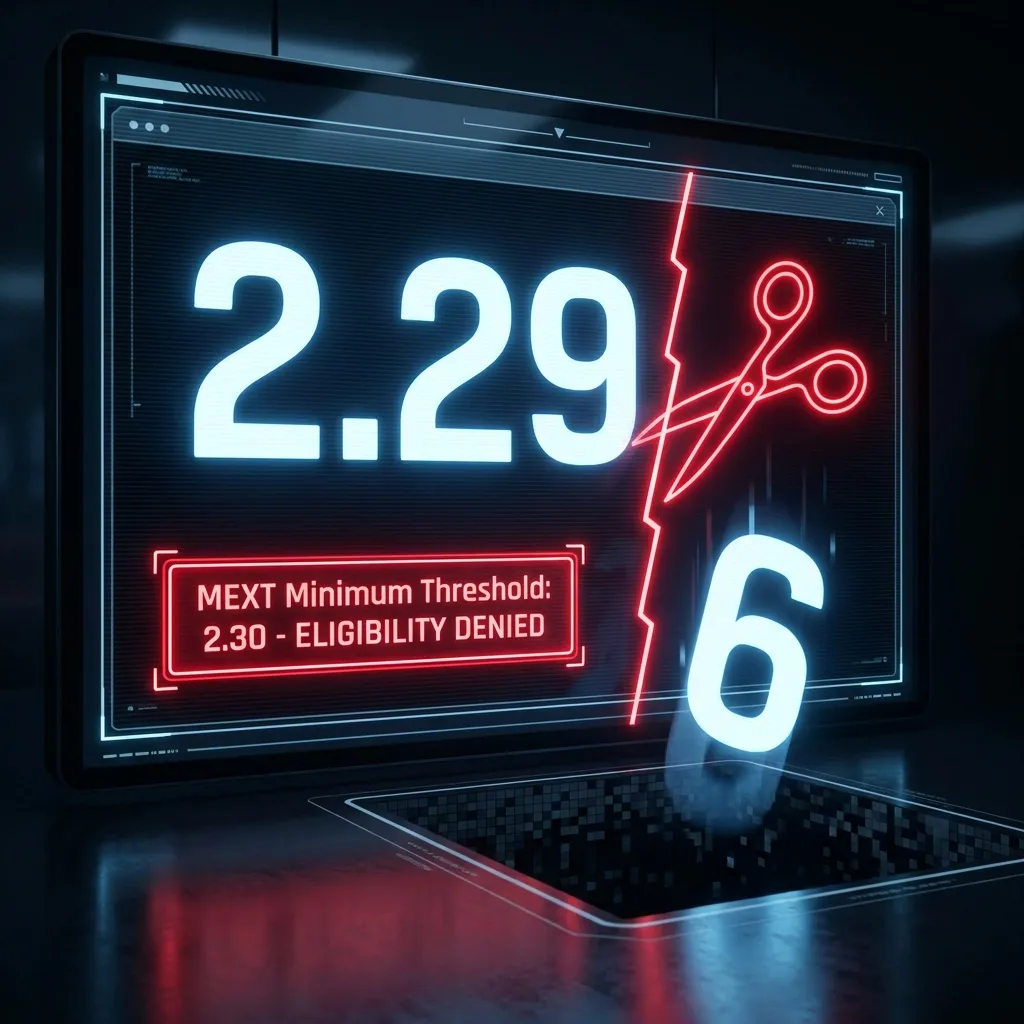
Many admissions screenings require a strict minimum threshold of 2.30 out of 3.00. If your calculated score comes out to 2.296, the system will not round your score up to a 2.30. The review board drops all trailing decimals past the second position. A score of 2.29 stands as a disqualification, making meticulous accuracy crucial.
Advanced Insights: Handling Edge-Case Transcripts
Standard guides assume every student has a clean transcript with standard semester credits. Real transcripts, however, are often messy. Use these rules to navigate unique academic scenarios.
-
Non-Traditional Credit Systems: If your home university uses a uniform course setup where every class counts equally without credit hours, assign a standard weight of 1 credit to every single course listed on your document.
The Recalculation Loophole for Retaken Courses: If you failed a course but successfully retook it later, how you calculate it depends on your university's transcript rules. If your home university completely replaces the old failing grade with the new passing grade on your final transcript, use only the new grade. However, if both attempts remain visible on your record, you must include both the 0-point attempt and the new point attempt in your formula.
-
Handling Thesis and Internships: Pass/Fail courses, ungraded research credits, and audited classes that do not provide a traditional grade value are completely removed from the calculation. Do not count their credits in the divisor.
Final Check
Taking the time to convert GPA to Japanese 3.0 scale standards gives you a clear look at your academic standing. Run these numbers before you start asking professors for letters of recommendation or writing detailed research proposals.
If your final tally clears the 2.30 barrier, your academic profile meets the base requirements. You can now confidently shift your energy toward building a compelling application for your target university program in Japan.