

Calculate Your GPA for German DAAD: The Complete Strategic Guide
Securing a German Academic Exchange Service DAAD scholarship is one of the most effective ways to fund your higher education in Germany. However, many highly qualified international students miss out because they do not realize that Germany evaluates academic performance on an inverted grading scale. In Germany, a 1.0 is the highest possible achievement, while a 4.0 represents the absolute minimum passing score.
If you submit your application without understanding how reviewers evaluate your academic history, you risk underestimating your competitiveness or misfilling vital portal entries. This strategic guide will show you exactly how to calculate your GPA for German DAAD applications using the official methodology mandated by German universities.
The Core Problem: Understanding Germany's Inverted Grading Scale
Related Reading: Check out our guide on Study in Hungary: Full Guide to Free Education
To build a compelling scholarship profile, you must stop looking at your grades through the lens of your local credit system. Whether your home country uses a 4.0 scale, a 10.0 cumulative grade point average (CGPA), or a 100% percentage framework, the DAAD selection committee will normalize everyone using a single baseline.
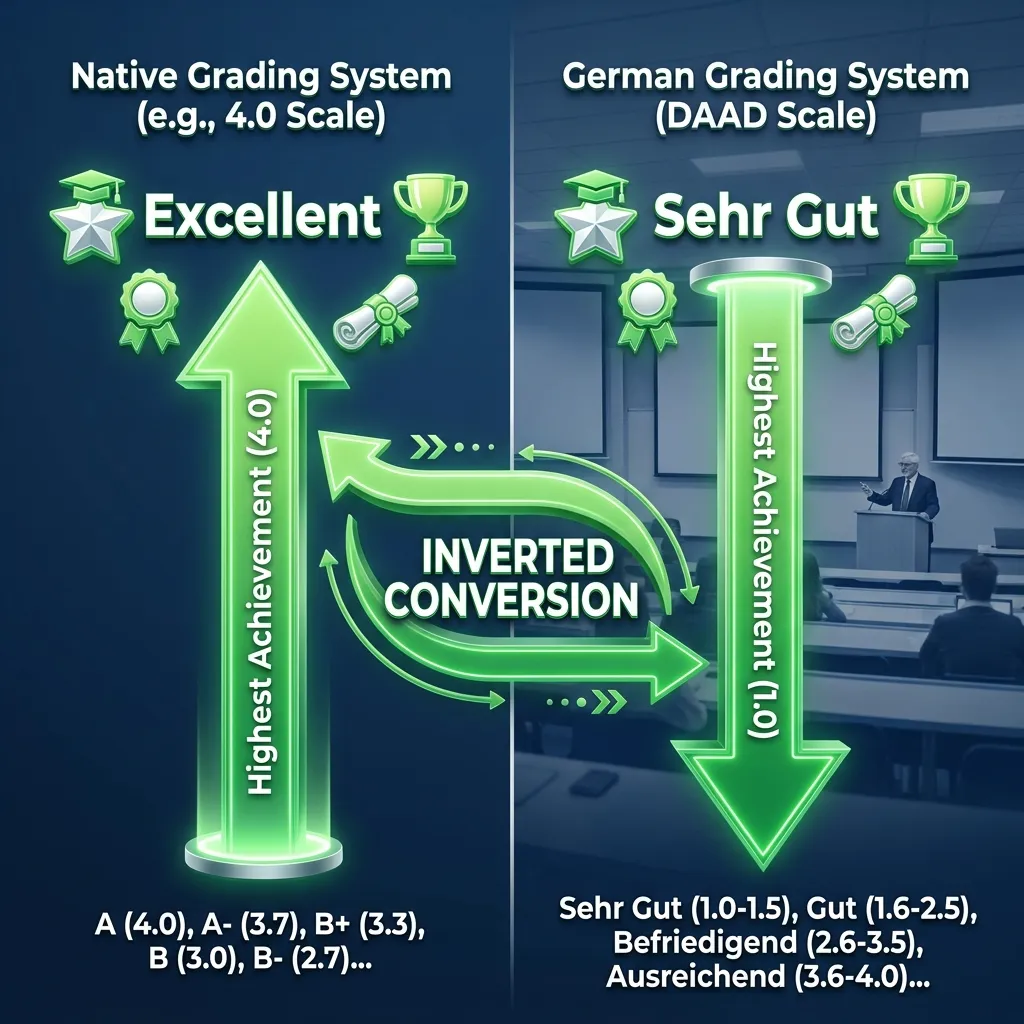
German higher education institutions rely heavily on a standardized mathematical framework known as the Modified Bavarian Formula (Bayerische Formel). This system translates your performance into a decimal point value between 1.0 and 5.0.
Here is what those converted numbers actually mean to a DAAD reviewer:
-
1.0 to 1.5 (Sehr Gut): Excellent. Your performance stands out significantly.
1.6 to 2.5 (Gut): Good. Your work is well above the academic average.
2.6 to 3.5 (Befriedigend): Satisfactory. Your scores meet average requirements.
3.6 to 4.0 (Ausreichend): Sufficient. Your profile meets the bare minimum to pass.
4.1 to 5.0 (Nicht Ausreichend): Fail. You do not qualify for institutional admission.
Step-by-Step: The Modified Bavarian Formula Explained
You do not need to wait for an official credential evaluation service like uni-assist to find out where you stand. You can compute this value yourself using a standard equation.
The official formula used to calculate your GPA for German DAAD submissions is structured as follows:

$$x = 1 + 3 \cdot \left(\frac{N_{\max} - N_d}{N_{\max} - N_{\min}}\right)$$
Where each variable represents a specific metric from your current academic transcript:
-
$x$ = Your resulting equivalent German grade.
$N_{\max}$ = The absolute highest grade achievable in your home grading system.
$N_{\min}$ = The lowest possible passing grade required to clear a course or degree in your home system.
$N_d$ = The current cumulative score or GPA you have achieved.
A Practical Walkthrough Example
Let us assume you graduated from an international university that grades on a 4.0 scale. To clear a class, your system requires a minimum passing grade of 2.0. Your final achieved cumulative score is a 3.5.
Let's plug these metrics directly into our variables:
-
$N_{\max} = 4.0$
$N_{\min} = 2.0$
$N_d = 3.5$
Now, we perform the calculation:
$$x = 1 + 3 \cdot \left(\frac{4.0 - 3.5}{4.0 - 2.0}\right)$$$$x = 1 + 3 \cdot \left(\frac{0.5}{2.0}\right)$$$$x = 1 + 3 \cdot (0.25)$$$$x = 1 + 0.75 = 1.75$$
Your final converted value is 1.75. On the German academic scale, this places you firmly in the "Gut" category, making your profile highly competitive for standard Master’s and Ph.D. scholarship pathways.
The Hidden Multiplier: ECTS Weights and Why "Simple Averages" Fail
Most top-ranking internet calculators make a massive mistake: they tell you to just plug your final cumulative GPA into the formula. While that gives you a rough estimate, it can actively harm your DAAD application if your university handles credit distributions differently.

The Problem with Local Transcripts
DAAD selection committees do not look exclusively at your final cumulative average. They look at your core subject relevance. If your home institution assigns the same weight to an advanced engineering thesis as it does to an introductory elective, a simple conversion will distort your true academic standing in the eyes of a German admissions office.
How to Compute a True ECTS-Weighted German GPA
To calculate your GPA for German DAAD profiles like an expert, you should calculate your score module by module using your course weights.
1.Isolate core modules:Step 1.
Identify all the core subjects on your transcript that directly align with the prerequisites of your target German degree program.
2.Convert individual grades:Step 2.
Apply the Modified Bavarian Formula to each individual module score separately, rather than just using your final cumulative average.
3.Multiply by local credit weights:Step 3.
Take your newly calculated German grade for each class and multiply it by the number of credit hours your home university allocated to that specific class.
4.Sum and divide:Step 4.
Add those weighted values together and divide the total by the sum of all credit hours completed. This gives you a highly precise, weighted German score.
Pro-Tip: If your local university has an unusually high passing bar (e.g., needing 60% just to pass instead of 40%), your $N_{\min}$ variable shifts significantly. This works to your advantage, making your calculated German score look much stronger because it reflects the difficulty of your native system. Always request an official grading legend from your registrar to prove your system's baseline.
Strategic Action Plan for Your DAAD Portal Submission
Once you calculate your GPA for German DAAD requirements, you must present this data strategically within your application package. Follow these three field-tested rules to maximize your admission chances:

-
Never mix systems arbitrarily: If the DAAD portal explicitly requests your grade in your native system, input it exactly as it appears on your official transcript. Do not try to convert it manually unless the form fields explicitly instruct you to provide the German equivalent.
Attach a clear grading legend: Always include the official back page of your academic transcript in your PDF uploads. This page contains the parameters for your system's highest possible score and minimum passing grade. Without this explicit context, reviewers may default to a standard regional baseline that could penalize your profile.
Highlight your upward academic trajectory: If your early semester scores were low but your final two years show a strong upward curve, explicitly highlight this pattern in your Letter of Motivation. German professors deeply value sustained academic development over time.
Expert Summary Checklist
Successfully maneuvering the DAAD application requires precision. Before hitting submit on your portal entry, verify your academic data against this checklist:
| Verification Target | Core Requirement | Strategic Purpose |
| Formula Variables | Confirmed $N_{\max}$ and $N_{\min}$ via official university documentation. | Prevents automatic disqualification due to faulty conversion baselines. |
| Inverted Scale Check | Verified that your target conversion falls between 1.0 and 2.5. | Ensures your profile meets the competitive tier for public funding. |
| Transcript Legend | Included the registrar’s grading criteria in your primary document upload. | Provides external validity for your local university's pass/fail thresholds. |
Ultimately, knowing how to calculate your GPA for German DAAD parameters allows you to take control of your application's narrative. Run your numbers carefully, back them up with verified institutional documentation, and frame your academic achievements clearly to stand out to the selection committee.